A dining chair is the most-used seat in most homes. It gets pulled out, pushed back, sat on through long breakfasts and longer dinners, and wiped down far more often than anything in the living room. Yet it is usually the last piece people choose carefully. Most dining rooms end up with chairs bought to match a table, in a quantity that fits the room, without anyone checking whether the seat is at a comfortable height or whether the back will still be tight in three years.
This guide covers the decisions that actually affect how a dining chair performs day after day: the relationship between seat and table, the space each chair needs, the joinery inside the frame, and the materials that survive a humid tropical climate. It is written for homes in Bali, where humidity, salt air in coastal areas, and open-plan layouts change what "good" looks like.
Start with the table, not the chair
Chairs are usually bought to fit a table that already exists, so the table sets the constraints. The single most important measurement is the gap between the top of the seat and the underside of the table apron. A comfortable target is roughly 25–30 cm. Too little and your thighs press against the apron; too much and you sit with your elbows lifted, which gets tiring within a meal.
In practice, that means a seat height around 43–46 cm suits the common dining table height of about 73–76 cm. If your table is unusually tall or has a deep apron, measure before ordering anything: a chair that looks right can still be unusable if the arms do not clear the table edge, or if the seat sits too low to reach the plate comfortably.
Also check the table's leg or trestle position. Chairs need to tuck under without the arms or the front legs colliding with the table base. On pedestal tables this is rarely an issue; on four-leg tables with wide corner legs, it often is.
How much room each chair really needs
Comfort at a dining table is mostly a spacing question, not an upholstery question. Three numbers cover most of it:
- Width per person: around 55–60 cm of table edge is the workable minimum for a standard place setting. Narrower and elbows compete; much wider and the table feels sparsely used.
- Pull-out space: you need roughly 75–90 cm from the table edge to whatever is behind the chair, so the chair can be drawn out and someone can stand up without sidestepping.
- Circulation behind seated diners: a walkway of about 90–100 cm lets people pass behind someone who is seated. Below that, guests end up apologising every time they move.
In an open-plan Bali home, the dining zone is often the through-route between kitchen and living area, which makes the circulation number more important than the table size. A slightly smaller table with proper clearance feels more generous than a large one wedged against a wall. The same circulation logic applies in the next room — see planning a living room layout. If the layout is genuinely tight, planning the seating and circulation together — which is what dining room design coordinates alongside lighting and storage — usually produces a better result than buying narrower chairs and hoping.
Seat height, depth and back angle
Beyond height, three details decide whether a chair is comfortable for an hour or for ten minutes:
- Seat depth: roughly 40–45 cm. If the seat is too deep, the front edge presses behind the knee and you slide forward to compensate, ending up perched.
- Back angle: a slight recline of about 5–10 degrees from vertical supports the lower back. Perfectly upright dining chairs look formal and read as uncomfortable after the first course.
- Front edge: a gently rounded or waterfall front edge reduces pressure on the thighs. A hard, square edge on a firm seat is the most common complaint on inexpensive chairs.
Armchairs are worth the extra width at the head of a table, but they need to clear the table apron when tucked in, and they take more floor space. A common compromise is armchairs at the ends and side chairs along the length — provided the seats are at the same height, so the table does not look uneven.
Frames and joinery: where the difference hides
Two chairs can look identical and behave completely differently after two years of daily use. The difference is in the frame. What to look for:
- Solid timber rather than veneered board in the legs and rails. Solid stock can be re-tightened and repaired; a failed particleboard joint usually cannot.
- Mortise-and-tenon or dowelled joints, not just screws into end grain. End-grain screws pull out under the rocking motion a chair takes every time someone leans back.
- Corner blocks or stretchers that brace the seat frame. Pick the chair up by two opposite corners and set it down; a frame that creaks or racks slightly out of square is already telling you something.
- Kiln-dried timber. In Bali's humidity, timber that was not properly dried moves after it reaches your house, and joints open. This matters more here than in a temperate climate.
Materials that hold up in tropical humidity
Humidity is the variable most furniture advice ignores. In Bali it affects timber, glue lines, cane and fabric, and it does so every month of the year.
Teak and other dense hardwoods
Teak is the default for a reason: its natural oil content makes it resistant to moisture and to insects, and it ages to a soft grey outdoors or keeps a warm tone indoors with occasional oiling. It is also heavy and stable, which is exactly what a chair frame wants. Other dense hardwoods work well too; the important part is that the timber is properly dried and the finish is appropriate for indoor or covered use. A teak dining chair that also uses natural rattan, such as the Nara Dining Chair in the ZEF Living collection, suits both air-conditioned dining rooms and shaded terraces.
Rattan and cane
Woven seats and backs breathe, which is a genuine advantage in a warm room, and they flex slightly under weight. The trade-off is that rattan dislikes standing water and long exposure to direct sun. Under a covered terrace it lasts well; left out in the rain through a wet season, it will sag and eventually crack. Cane seats can be re-woven, which is worth knowing before you discard a chair with a sound frame.
Upholstery
For a dining chair, the priorities are cleanability and breathability rather than softness. Tight-weave linen and cotton-look blends handle crumbs and spills; bouclé looks generous but traps everything and is difficult to spot-clean. If the chairs will be used by children or on a terrace, a removable cover or a performance weave is the practical choice. Foam density matters as much as the fabric: a soft seat that compresses to the frame within a year is a false economy.
What to avoid
Thin veneered board in legs and seat frames, unsealed MDF, and metal frames with painted finishes that chip in coastal air. Each of these fails in a way that cannot be repaired economically.
Indoor dining versus a shaded terrace
Many Bali homes have two eating areas, and they need different chairs. An indoor dining chair can carry upholstery, a lighter finish and a more refined profile. A terrace chair needs to tolerate humidity swings, occasional wind-driven rain and stronger sun. If the terrace is fully covered, an indoor-grade chair will usually survive; if it is open to the sky, choose a frame and seat that are designed to get wet and dry out, and accept that the finish will weather.
Mixing upholstery across both areas is a common mistake: the indoor set and the outdoor set end up looking like two unrelated purchases. Sharing a timber and a seat height across both rooms keeps the two zones legible as one home. The same principle applies to how the dining area meets the garden — covered in indoor-outdoor living.
How many chairs, and should they all match?
Count the people who actually live in the house, then add two for guests. Chairs that are never used still take up circulation space, and in a small dining room the fourth and fifth spare chairs are often what makes the room feel cramped.
A bench along one side is an efficient way to seat more people in less depth, and it reads well against a wall in an open-plan room. The compromise is that a bench is harder to get in and out of, and it fixes the seating position — the same trade-off that comes up when comparing built-in and freestanding furniture. Mixed seating — bench on one side, chairs on the other — works when the bench side faces a wall rather than a walkway.
Test a chair before you commit
If you can sit in the chair before buying, do these five things rather than judging it for ten seconds:
- Sit for at least a few minutes with your feet flat and your back against the backrest. If you want to move within thirty seconds, the seat depth or angle is wrong for you.
- Press down on one front corner and then the opposite back corner. Any movement or creak is a joinery warning.
- Check where the seat edge meets the back of your knee — there should be two or three fingers of clearance.
- Rest your forearms on the table height. If your shoulders lift, the seat is too low for the table.
- Lift the chair. A chair that is surprisingly light for its size is usually thin stock or hollow construction.
When ordering remotely, ask for the seat height, seat depth, overall width, arm height and the weight of the chair. Those five numbers answer most of the questions a photograph cannot.
Made-to-order versus ready-made
Ready-made chairs win on speed and, usually, on price per unit. Made-to-order makes sense in three situations: the table is a non-standard height or shape, the room needs a specific width to keep circulation open, or the material and finish have to match joinery elsewhere in the house.
Custom production in Bali typically runs on a lead time measured in weeks rather than days, and the useful part is not the shape alone — it is being able to specify the timber, the seat material and the dimensions together; the same logic that governs a custom interior build. In the ZEF Living collection, pieces are made to order and can be tailored in size, timber and upholstery, with the studio confirming details before production begins. That conversation is also the moment to settle the questions in this guide: seat height against your table, clearance against your room, and material against whether the chair lives indoors or under a roof.
A short checklist
- Seat height 43–46 cm for a 73–76 cm table; 25–30 cm from seat to apron.
- 55–60 cm of table edge per person; 75–90 cm pull-out; 90–100 cm behind seated diners.
- Seat depth 40–45 cm, back reclined 5–10 degrees, rounded front edge.
- Solid timber, mortise-and-tenon or dowelled joints, kiln-dried stock.
- Teak or dense hardwood for the frame; rattan only under cover; cleanable upholstery for daily use.
- Buy for the number of people who actually sit down, plus two.
- If ordering remotely, get the five measurements in writing.
Dining chairs are one of the few purchases where the specification matters more than the styling. Get the height and clearance right, buy a frame that can be repaired, and choose materials that tolerate the climate — and the chairs will still be doing their job long after the trend that inspired them has passed. If you would rather have the layout and the seating resolved together, the studio can plan the whole dining area, from table proportions and chair spacing to lighting and storage; start a project or browse the furniture collection to see the current pieces and finishes.
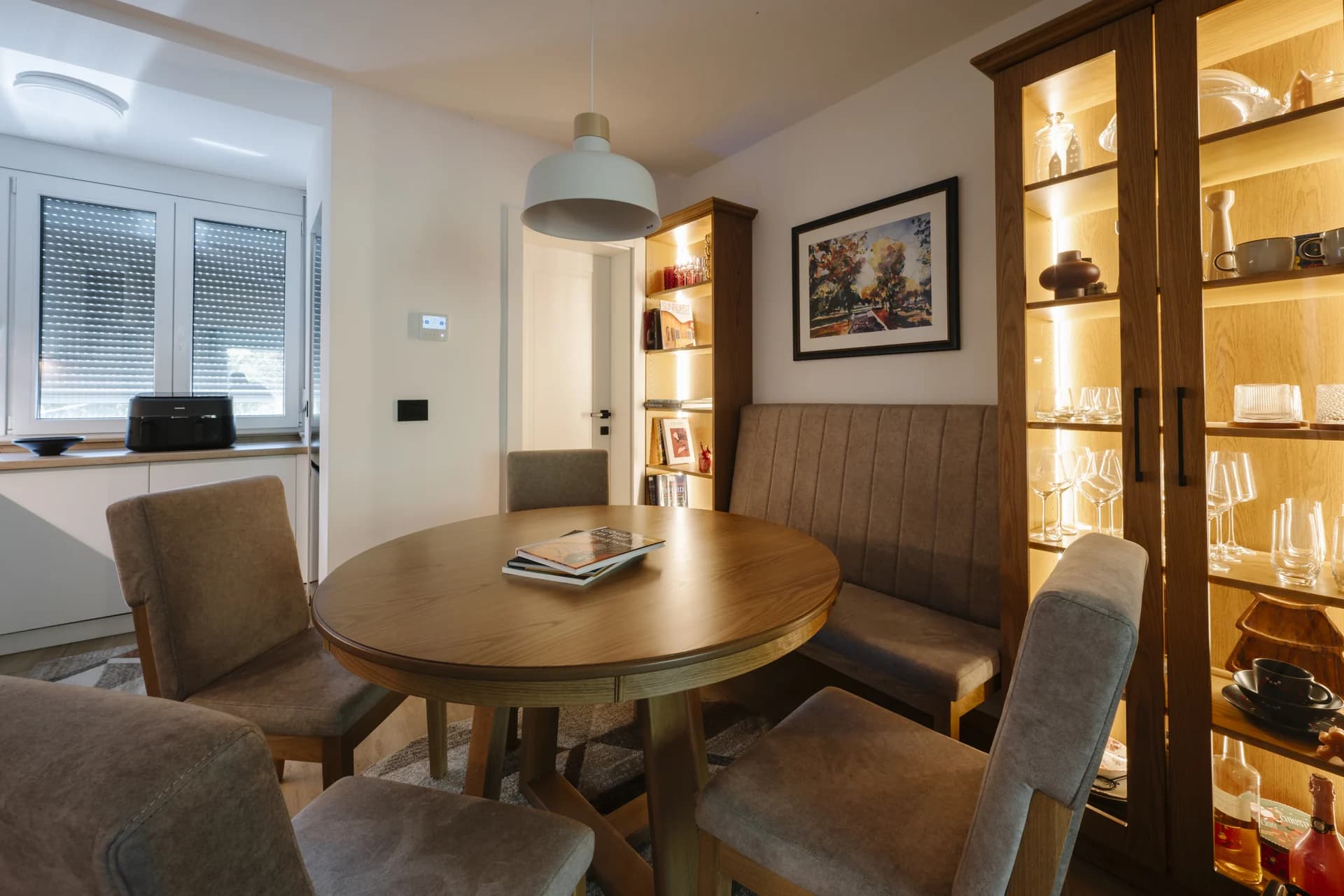
Cover photo: “Dining area with wooden table and chairs in a bright room” by Shixart1985, via Wikimedia Commons, licensed CC BY 2.0; resized for this page. Illustrative image, not a ZEF Living project.